Kurnik: the Russian chicken pie
Russia · Kurnik (курник)
Kurnik is a tall, domed Russian celebration pie traditionally filled with chicken, often layered with rice, mushrooms, buckwheat, or eggs, and historically served at weddings and major feasts. Its name comes from kuritsa, the Russian word for chicken, and it is sometimes called the king of Russian pies.
By the chickenpie.net test kitchen · Published 8 July 2026
Where it comes from
Kurnik belongs to the very old Russian tradition of pirogi, filled pies that mark hospitality and celebration. Written references to kurnik appear in Russian sources from at least the nineteenth century, and food historians generally agree the pie is older than that, though exact origins are not documented. It is most strongly associated with southern Russia and the Cossack regions of the Don and Kuban, where it was reportedly a fixture of festive tables.
The pie's best-known role was at weddings. By many accounts, two kurniks were made: one for the groom's household and one for the bride's, sometimes decorated differently to signal each family. The dome shape is often said to echo a peasant hat or a church cupola, though these readings are folk explanations rather than settled fact.
In the Soviet period the wedding ritual largely faded, but the pie survived as festive home cooking. Today kurnik appears in Russian cookbooks and home kitchens as a special-occasion dish, and simplified single-filling versions are common. Restaurants in Russia occasionally revive the grand layered version, and food writers regularly cite kurnik when arguing for the depth and ambition of the Russian pie tradition.
How it is traditionally made
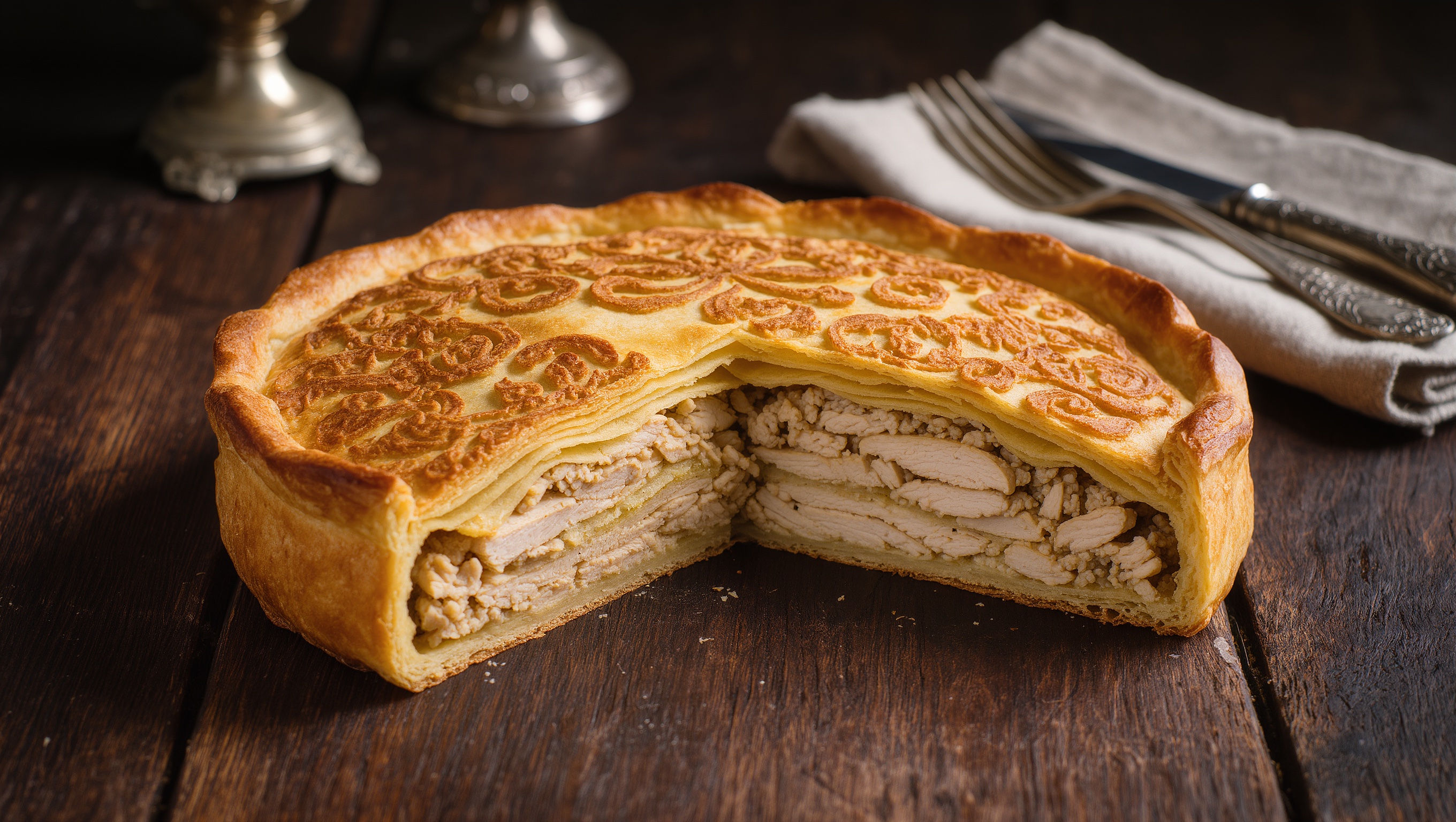
The classic kurnik is built as a layered construction inside a pastry shell. The dough is commonly a rich yeasted or short pastry made with butter or smetana, sturdy enough to hold a tall dome. Fillings are cooked separately: poached chicken taken off the bone, rice or buckwheat kasha, sautéed mushrooms with onion, and chopped hard-boiled eggs with herbs, each moistened with broth or a little sauce.
Traditionally the layers are separated by thin crepe-like pancakes called blini, which keep the fillings distinct and stop the pastry base going soggy. The fillings and pancakes are stacked in a rising mound, then a large sheet of pastry is draped over the top and sealed to the base, pleated and decorated, with a hole left in the crown so steam can escape. Wedding kurniks were often ornamented with pastry flowers, braids, or figures.
The pie is baked until deep golden and usually rested before cutting, so wedges hold their layers. It is served warm, often with broth alongside, and is a centerpiece dish rather than a snack.
What surprises a British or American cook
A cook used to British or American chicken pie will find kurnik drier and far more architectural. There is no pourable gravy inside: the moisture comes from broth-dressed fillings, and pancakes between layers replace the single saucy filling. It is also a tall freestanding dome rather than a dish-baked pie, and it is tied to celebration rather than everyday supper.